Where this fits
DCEPrep automates steps 2 through 6. The full DCEasy pipeline:
A preprocessing and analysis pipeline for Dynamic Contrast-Enhanced (DCE) MRI data.
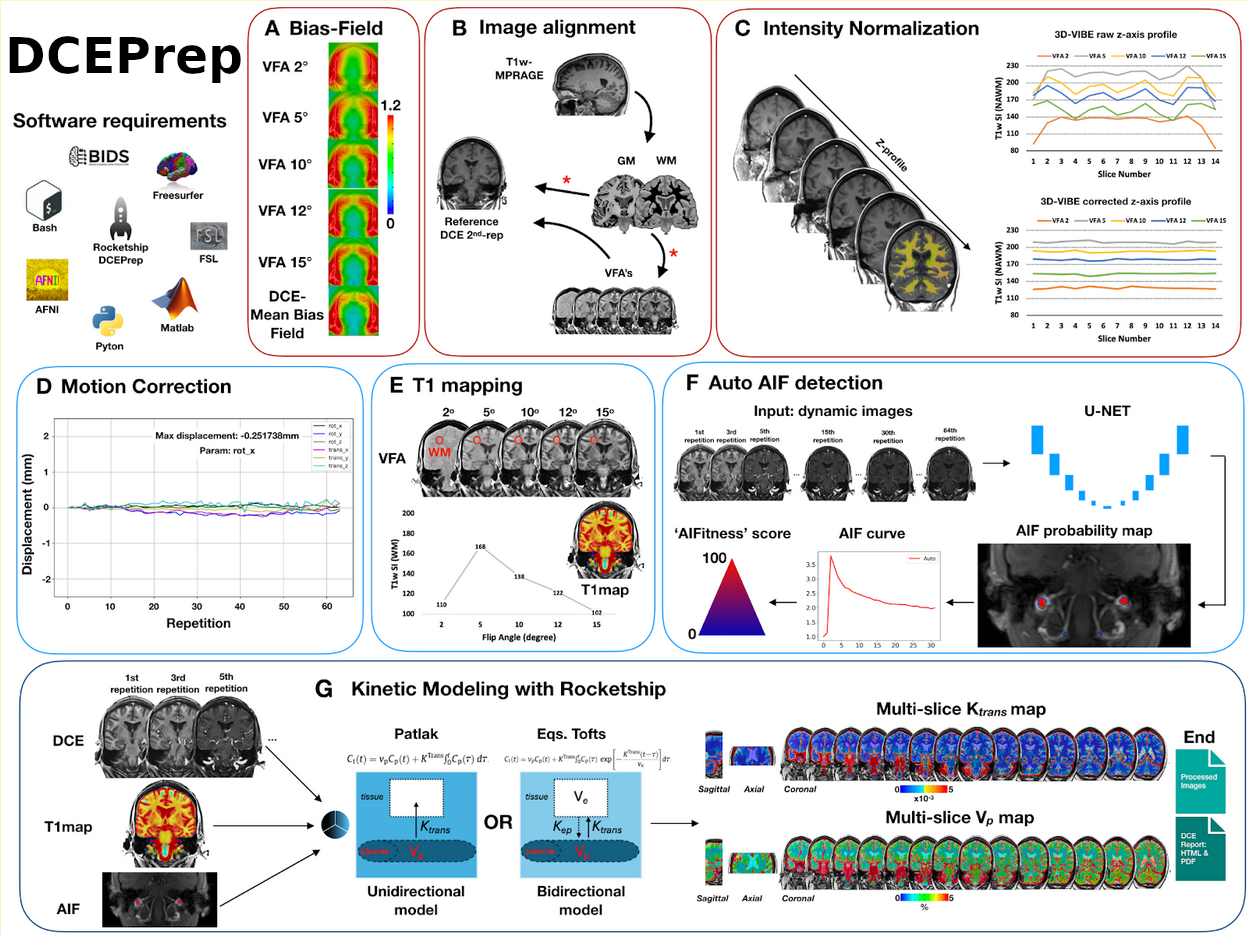
DCEPrep handles the full workflow for measuring permeability (Ktrans) from DCE-MRI acquisitions — from raw DICOM to publication-ready QC reports.
What Does DCEPrep Do?
DCEPrep takes BIDS-organized MRI data and runs a two-phase pipeline:
Phase 1 — Preprocessing (preprocess_all.sh)
Prepares raw DCE and VFA images for kinetic modeling. Steps include brain extraction, image registration, bias field correction, z-axis normalization, T1 mapping, and arterial input function (AIF) selection.
Phase 2 — Analysis (DCE_all.sh)
Runs pharmacokinetic modeling via ROCKETSHIP to produce Ktrans permeability maps, then generates per-case and population-level HTML/PDF QC reports.
Key Features
- Fully scriptable — driven by two shell scripts with straightforward CLI flags
- BIDS-native — expects and produces BIDS-compliant data structures
- Docker-first — a single container bundles FSL, ANTs, FreeSurfer, MATLAB, and ROCKETSHIP
- Automated AIF — optional neural-network-based arterial input function detection
- Variance Reduction — z-axis normalization and bias correction designed to reduce scanner variability
- Automated QC — per-case and population HTML reports with outlier detection
- GPU acceleration — Several steps utilize optional CUDA-based acceleration for faster processing
The DCEasy family
DCEPrep is one of several DCEasy tools for DCE-MRI processing, including ROCKETSHIP, AutoAIF, and dce2bids. See dceasy.org for an overview of the full family.
See ROCKETSHIP Integration for details on the MATLAB dependency.
Quick Links
- Installation
- Process Data
- Preprocessing Pipeline
- Analysis Pipeline
- CLI Reference — Preprocessing
- CLI Reference — Analysis
Citation
If you use DCEPrep in your research, please cite:
Barnes S, et al. Automated DCE-MRI processing with DCEPrep for Blood-Brain Barrier permeability in a multi-site aging study. Pending. 2026.